

How to achieve secure flexibility in complex processes
When a manufacturing company is faced with labor shortages and high production demands, automation seems like the obvious solution. However, the challenge at Schuster Bestuhlungen in Kaiserslautern was not automation itself, but finding a solution that fits the actual workflows and is accepted by all employees – without jeopardizing the company's success factors.
For over 30 years, the family-run company has been supplying lecture hall and auditorium seating for educational and public institutions throughout Germany. The products are subject to high standards and must comply with the specified requirements.
What distinguishes Schuster Bestuhlungen is its ability to carry out complete projects: from individual precision work in wood and metal to upholstery and on-site assembly. This integrated approach offers flexibility, but also brings complexity. Every department must work together smoothly. Bottlenecks in one area affect the entire workflow.
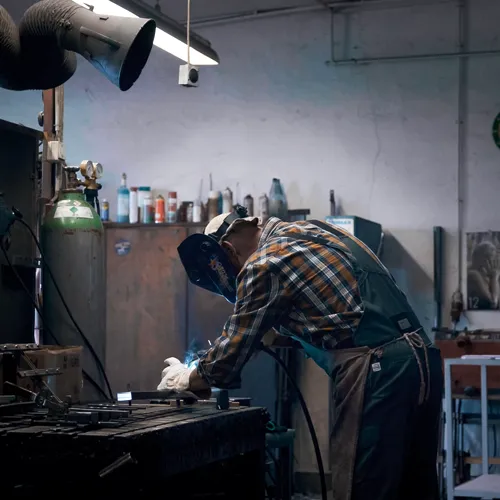
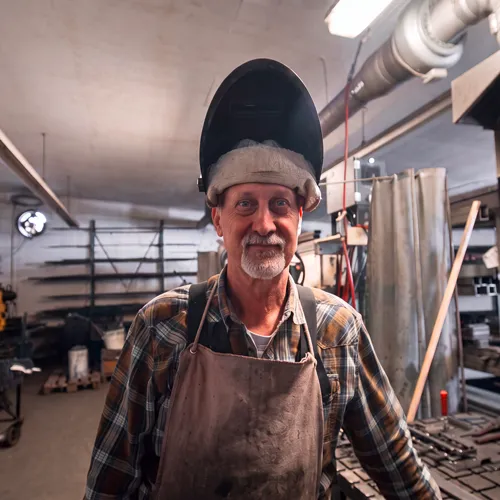
Compliance with these standards during welding was very labor-intensive. Products such as lecture hall stands and stage substructures required numerous welding steps, often with different templates and tools for each component, which frequently had to be changed. This meant that the components had to be moved manually several times between the individual stations. A team of two to three welders was usually required for a single product – an immense personnel commitment with an equally high risk.
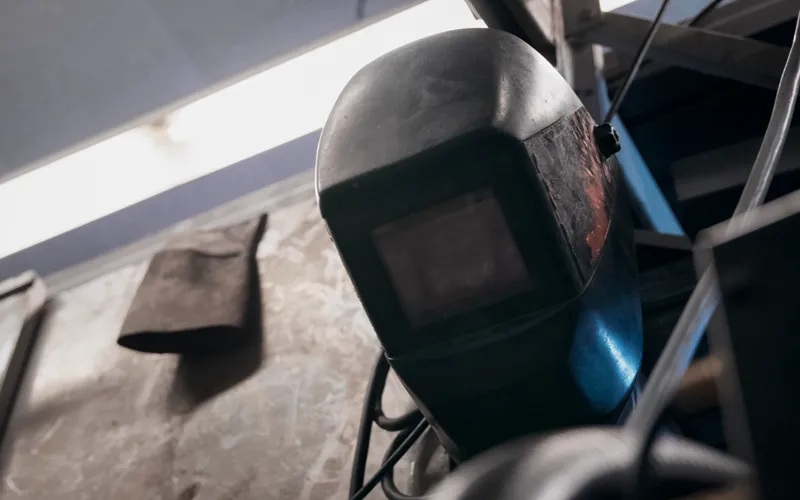
Even skilled welders experienced minor deviations in the welded parts, including across layers. This inconsistency sometimes led to rework during assembly. The physical strain was considerable: hours of working in welding positions, exposure to fume and electric arcs. It became increasingly difficult to find qualified welders who were willing to work under these conditions.
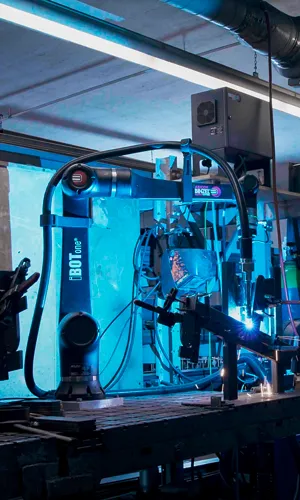
The path to automation began for Schuster Bestuhlungen over ten years ago with a CNC machining center for woodworking. This investment marked a turning point, as it simplified processes and increased efficiency: one employee operates the machine, while the others can concentrate on painting, upholstery work, metalworking, or assembly. Precision improved noticeably. Drilling inaccuracies that led to deviations of 2–3 mm were a thing of the past.
This positive experience led to the idea of exploring automation options in other areas as well, thereby relieving employees of monotonous tasks. Intelligent automation should expand human capabilities rather than replace them. With this in mind, Schuster Bestuhlungen decided to explore the automation of welding.
However, many commercial solutions were designed for large manufacturers with high production volumes and their own development teams. A solution for Schuster Bestuhlungen must also work for customer-specific projects and at the same time cope with the large variety of projects.
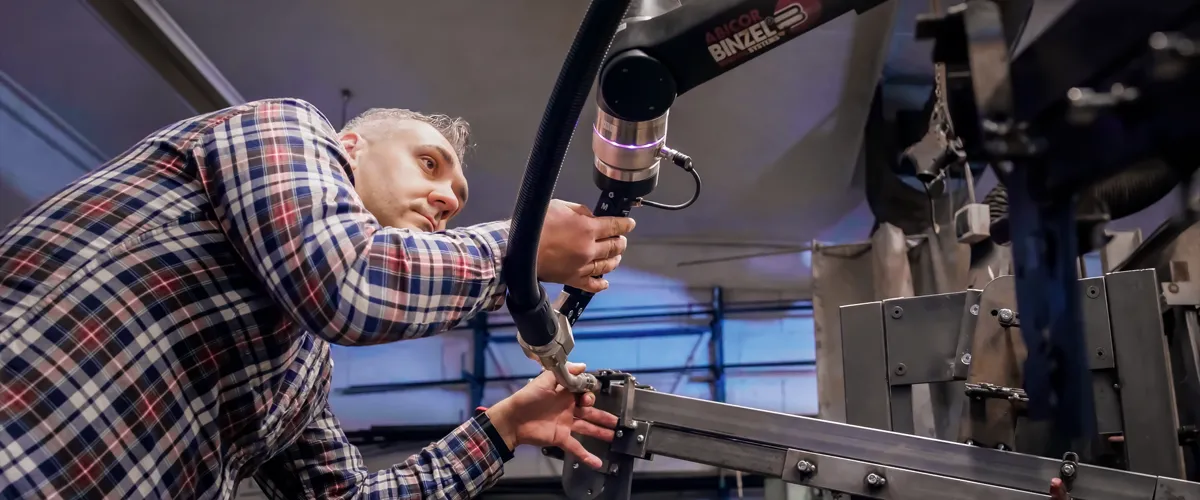
It should offer flexibility similar to that of a CNC machining center and also be operable by non-specialists. Their choice fell on the iBOTone® welding cobot from ABICOR BINZEL. The welding technology specialist offered to put the iBOTone® through its paces in everyday production. For two months, the team was able to evaluate the welding cobot themselves under real production conditions, ask questions, and experience the results firsthand.
The iBOTone® is a collaborative welding robot that combines the advanced robot technology of NEURA Robotics with the comprehensive welding expertise of ABICOR BINZEL. On the one hand, this welding cobot is ideal for getting started with automation. On the other hand, its ease of use and high flexibility ensure consistent quality even with frequently changing welding applications. The iBOTone® makes professional welding automation accessible to companies of all sizes.
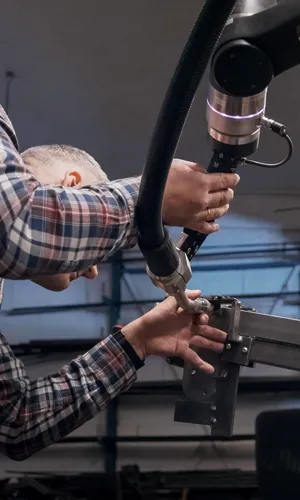
Operation is incredibly simple: The easy teach handle makes it very easy to move the welding torch from position to position. Individual waypoints can be saved directly on the torch holder. No complicated programming. No complex interfaces.
Within minutes, anyone can set up the welding of new parts and operate the system. The quick introduction surprised even Schuster Bestuhlungen. The team was ready to go in no time and integrated the iBOTone® into the production of components such as seat swivel mounts, auditorium stands, and steel substructures for stage platforms.
“The iBOTone® offers us the same flexibility and efficiency in welding that our CNC machine gave us years ago in woodworking. But now anyone can weld. That's a real breakthrough for us”, emphasizes Ronald Schunn, Operations Manager at Schuster Bestuhlungen. “Given the shortage of skilled workers and the desire for modern, flexible workplaces, we see this as an opportunity to future-proof our company.”
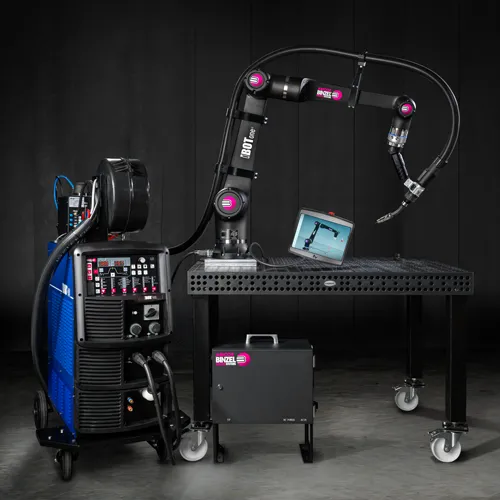
All welding processes are now carried out using iBOTone®. The implementation of this welding cobot has led to measurable improvements in production efficiency, quality, and working conditions:
Production efficiency
By eliminating the need for retrofitting and multiple manual operations, welding time per part has been significantly reduced while throughput has increased. One employee operates the cobot and simultaneously performs other production tasks.
Quality
Every weld seam is identical to the next – regardless of who performs the work or changing shift operations. No reworking. No assembly adjustments. The components fit perfectly every time. The number of rejects or defects has also been significantly reduced.
Working conditions
All employees are significantly less exposed to welding fumes and arc radiation. The monotonous work is performed by the iBOTone® welding cobot. Physical strain has also been reduced. The modern system attracts younger potential employees who might otherwise have avoided traditional manufacturing professions.
Schuster Bestuhlungen has not lost any employees as a result of automation. The company now deploys its skilled workers in a more targeted manner. Qualified workers now also carry out installations and adjustments on site – tasks that require real expertise and problem-solving skills. The company, which employs three to four welders, has increased its efficiency through more strategic team composition. This development was achieved through better organization and not through layoffs.
At the same time, employee satisfaction increased. Welding specialists can perform other tasks while the cobot welds. They no longer have to concentrate on a single component for long periods of time.
For small and medium-sized manufacturing companies, the question is not whether to automate, but how to make it work intelligently. The story of Schuster Bestuhlungen shows that advanced robotics can complement craftsmanship rather than replace it. The right technology increases efficiency without compromising a company's success factors. It supports employees instead of replacing them. It creates jobs that attract young talent while valuing the experience of long-standing team members.
Ronald Schunn explains it this way: “The cobot relieves our employees of monotonous, physically demanding tasks so that they can concentrate on activities that require real expertise. Everyone benefits from this.”
