

Flexible automation for professional conveyor and sorting systems

How Interroll is entering the field of collaborative welding automation with the iBOTone®
Anyone who visits the Interroll plant in Obrigheim quickly realizes: The focus here is on motion. Not just on the roads surrounding the modern facility in the Neckar valley, but above all in the production halls. That is where components and assemblies for conveyor and sorting systems are manufactured – systems that reliably deliver packages, luggage, and goods to their destinations worldwide.
The factory grounds appear large and spacious. The facility, which was only occupied in 2021, offers modern manufacturing conditions and provides sufficient space for future growth. Approximately 350 employees work here on intralogistics solutions. Many of the products leave the plant as part of complex conveyor systems that move thousands of goods every day. Welding technology plays a central role in this process, and recently, collaborative welding automation has also become a key factor – with the iBOTone® cobot welding robot.
All information at a glance
- Conveyor technology for the logistics of tomorrow
- From small series to quantities of several thousand
- Why a traditional industrial robot is not the best solution
- The Implemented System at a Glance
- Developed collaboratively: A practical concept for real-world application
- Fully prepared for the task
- Welding fume extraction at the source
- Support beyond installation
- Skilled workers and cobots working as a team
- Smooth product flows with sophisticated manufacturing technology
- Documentation
Interroll Conveyor GmbH is part of Interroll Holding AG, located in Switzerland, and is a leading global provider of material handling solutions. Whether in package distribution centers, e-commerce warehouses or industrial production facilities – wherever products need to be transported, sorted, or distributed – the company’s systems are in use. At the facility in Obrigheim, the company manufactures, among other things, assemblies for sorting and conveyor systems. The requirements are diverse: In addition to smaller batch sizes, components are regularly manufactured that are needed in significantly higher quantities.
“We have many different products and assemblies. At the same time, there are some components that we constantly need in large quantities”, explains Andreas Leiss, Production Planner at Interroll. It was precisely this combination of product variety and recurring components that led the company to ask how welding processes could be automated economically without losing the necessary flexibility.
“We want to increase the use of welded joints. They are robust, durable, and often provide a better solution for our applications.“
Andreas Leiss
While many components are manufactured in quantities ranging from 20 to 100, there are also orders for large-scale projects within production. These include, for example, assemblies for so-called sorting carts. These assemblies are an important component of complex sorting systems and, depending on the project, are required in large quantities. A single system may require several hundred to over a thousand of these assemblies. The total demand is approximately 6,000 units per year.
At the same time, Interroll is pursuing a clear manufacturing strategy: Certain connections will be welded rather than bolted in the future. “We want to increase the use of welded joints. They are robust, durable, and often provide a better solution for our applications”, explains Andreas Leiss. As a result, the question of finding a suitable automation solution for welding has become even more important.

Interroll had already gained some initial experience with automated welding processes. However, a previously used industrial robot was not suitable for long-term integration into day-to-day production. The manufacturing requirements were simply too varied. Frequent changes in components, as well as small and large batch sizes and the resulting need for flexible adjustments, made it difficult to achieve high utilization rates.
Therefore, the company was looking for a solution that would make the welders’ work easier, allow them to quickly adapt to new tasks, and integrate smoothly into existing workflows. That is how the iBOTone® from ABICOR BINZEL came into play as a complete system, together with an xFUME® ABIROB® extraction torch, the matching xFUME® COMMANDER extraction unit, and an iROB® 401 power source.
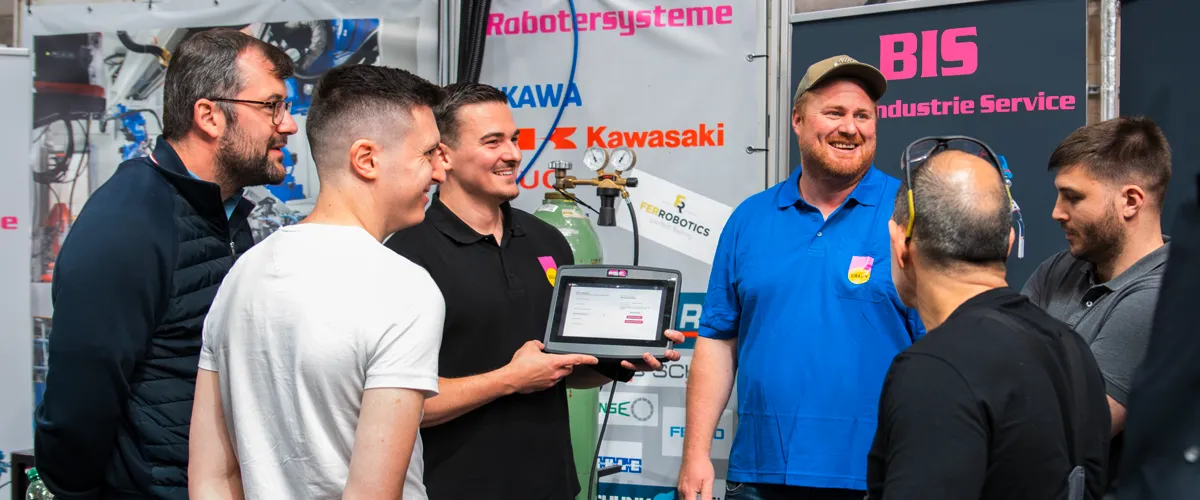
Interroll had already been introduced to the iBOTone® during a visit by an ABICOR BINZEL team that brought the Traderunner to their facility. It was extremely important to the company’s management that all welding specialists – from both the early and late shifts – be able to thoroughly test the iBOTone®, particularly its operation and the teaching of components. In addition, the entire management team at the production site, including plant management, was present. Since this visit took place on a cold November day, the Traderunner was quickly moved into the production hall. This provided sufficient time, under comfortable conditions, for all welding specialists and decision-makers to gain a thorough understanding of ABICOR BINZEL’s iBOTone® cobot welding robot.
The partnership between Interroll and BIS Braun Industrie Service – an integrator that has specialized in robotic system engineering for over 30 years – ultimately arose from the fact that the company is an official partner of ABICOR BINZEL in the state of Baden-Württemberg, specifically for cobot systems. Following initial discussions and an analysis of the manufacturing requirements, this led to a joint automation project.
“We ultimately decided on the iBOTone® because we see its greatest advantage in the ease of use. That means easy programming. We consider this a major advantage, especially for small series or single-unit production and for newcomers to the robotic system”, explains Kevin Braun, Junior Managing Director at BIS Braun and Project Manager for this project.

With the iBOTone® welding cobot from ABICOR BINZEL, you are taking the smart path in automation. With cobot welding, you can complete welding work of any batch size with consistent quality and no downtime.

MIG/MAG Welding Torch System ABIROB® W
The modular design of these rugged yet flexible torches allows a fast change of torch neck and cable assembly components without the TCP (Tool Centre Point) changing – thus avoiding additional programming effort.

Welding fume extraction system xFUME® COMMANDER
This modular, flexible powerhouse battles harmful welding fumes in the workshop and production area. This solution is suitable for manual welding workstations as well as for cobot welding robots and industrial robots. Find out more here!

iROB® – Power sources for robot welding
The new iROB® power source series now completes the extensive range of everything you need for an excellent weld seam. With this automation solution you can reach the next level in your production.

Instead of designing the facility around the technology, the approach was reversed: The focus was initially on Interroll’s components and manufacturing processes.
Together with BIS Braun, a concept was developed based on four independent workstations, all of which are served by a single, centrally located cobot welding robot. This allows different workpieces to be prepared, reloaded, or removed in parallel while the iBOTone® is already welding at another station.
“From the very beginning, the goal was to maximize the cobot’s utilization and integrate it flexibly into our day-to-day production”, says Andreas Leiss, describing the project concept.
A particular advantage is the flexibility in the sequence of operations. The iBOTone® can move sequentially between different stations and execute various programs. Each station is equipped with sensors or laser barriers at the corners to ensure the highest possible level of safety for humans during collaborative work. Even larger components can be integrated thanks to the flexible design of the work areas. The system thus combines the advantages of automated welding processes with the adaptability of manual manufacturing.
Before the cobot welding robot was transported to Obrigheim, it was fully assembled at BIS Braun and put through its paces. The official factory acceptance test also took place there.
Interroll’s welding specialists once again had the opportunity to teach the system themselves, test programs, and weld actual components. Among other things, they welded sorting cart assemblies with multiple fillet and vertical welds.
In particular, the quality of the vertical seams drew positive feedback. “I was skeptical about the vertical seams at first. But the result really won me over”, concluded an experienced welder after the first test runs.
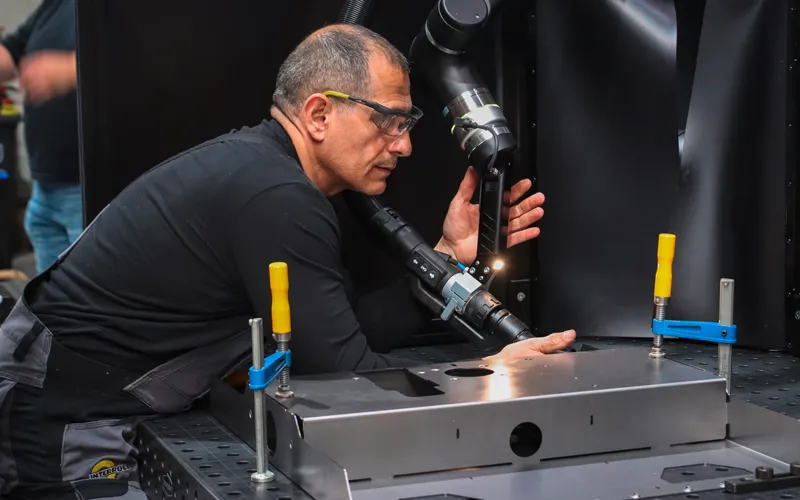
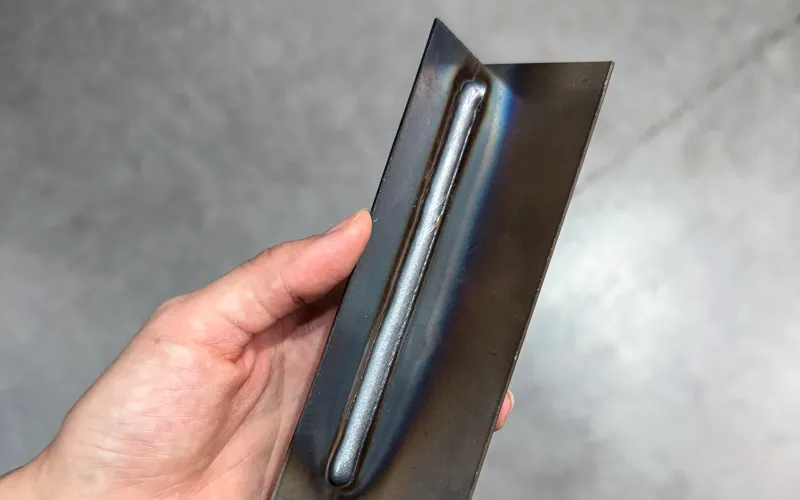
Quality assurance and production planning were also satisfied. The welded components met the requirements immediately and could be used without any rework. Following successful acceptance with an official signature from the client, Interroll, the system was dismantled, loaded, and transported the following day to the Interroll site in Obrigheim. There, the BIS Braun team assembled the system in close coordination with the responsible persons on site.

"If we’re going to invest in new technology, we also want to do something to protect the health of our employees."
Kathleen Krebs
In addition to productivity and flexibility, occupational safety also played an important role in the project decision. The decision-makers at Interroll deliberately chose a solution with integrated welding fume extraction. The system utilizes the xFUME® ABIROB® robotic extraction torch and the xFUME® COMMANDER extraction unit from ABICOR BINZEL. The fumes are extracted directly at the source, reducing exposure to welding fumes immediately during the process.
“If we’re going to invest in new technology, we also want to do something to protect the health of our employees”, says Kathleen Krebs, Head of Industrial Engineering at Interroll, explaining the reasoning behind this decision. The choice of a torch-integrated extraction system was no coincidence. Experience with centralized extraction systems had shown that extraction directly at the process is the more effective solution for both manufacturing requirements and occupational health and safety.
For BIS Braun, as an integrator, the project does not end with the installation of the system. From the initial consultation through preliminary testing to commissioning, the company supports their customers throughout the entire project. Commissioning is followed by a phase of intensive practical experience. Employees gather insights during daily operations, document potential areas for optimization, and continue to develop the application in collaboration with BIS Braun. “The real work begins after handover. Everyday operations then reveal where there is still room for improvement and how we can best support our customers”, explains Christian Heinzelmann, Technical Sales Manager for Robotics and Welding Applications at BIS Braun.

“We can see that cobot solutions are becoming increasingly important.“
Kevin Braun
The high level of acceptance of the automation solution within the manufacturing department is remarkable. The welding specialists were involved in the decision-making processes from the very beginning and were able to actively contribute to the development.
Today, the iBOTone® complements existing manual welding workstations rather than replacing them. The goal is not to remove people from the process, but to utilize their skills in a more targeted manner, make their work more efficient, and create additional capacity. In doing so, Interroll is pursuing an approach that is becoming increasingly important in many manufacturing facilities: using automation where it creates real added value while simultaneously fostering employees’ expertise.
“We can see that cobot solutions are becoming increasingly important. This is, of course, a major issue, especially for small and medium-sized businesses, driven by the shortage of skilled workers we are facing in Germany”, Kevin Braun points out.
“Automating the welding process is important to us because we have a wide variety of stamped and bent parts that we can weld together into assemblies. This means we operate in a project-based business, so we need to be highly flexible while also being able to handle small- to medium-volume production series. To automate this process, a welding cobot that works alongside humans is exactly the right solution for us”, explains Kathleen Krebs.
Every day, millions of packages, products, and pieces of luggage make their way through conveyor and sorting systems around the world. Hardly anyone stops to think about the highly complex technology behind these processes.
With the iBOTone®, Interroll has found a way to combine modern welding automation with the requirements of flexible manufacturing. In collaboration with BIS Braun and ABICOR BINZEL’s welding technology, a solution was developed that improves productivity, quality, and workplace safety. Or, in other words: Wherever goods are moved today, there is also a piece of collaborative welding automation from Obrigheim behind it, powered by ABICOR BINZEL.
