

Wire feeder systems | ABICOR BINZEL
Wire feeder systems for automated laser welding and manual hand-held laser welding
Wire feeder systems from ABICOR BINZEL stand for precision, especially when feeding soft and thin welding wires. They guarantee high-quality weld seams in automated laser welding and laser brazing as well as in hand-guided laser welding.
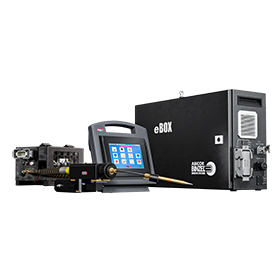
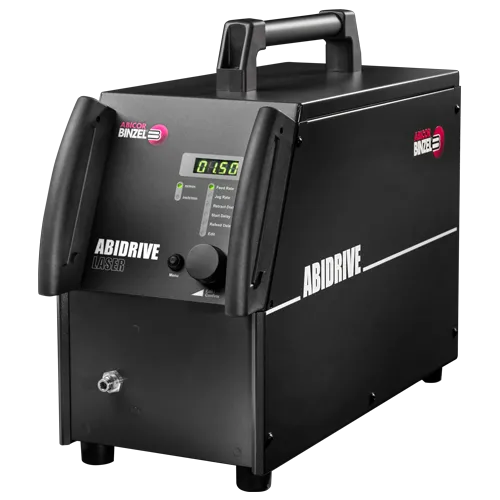
All information at a glance:
Advantages of ABICOR BINZEL wire feeder systems
High-precision wire feeding is particularly important in laser welding and laser brazing. Wire feeder systems have long been standard in the automotive industry, where precision seams are not only a visual feature but also ensure the stability of the joint. Lasers are now also being used increasingly in manual welding.
Wire feeder systems from ABICOR BINZEL ensure reliable and highly accurate wire feeding.
Advantages of ABICOR BINZEL wire feed systems for welding robots:
- Fast, precise wire feeding
- Very user-friendly interface
- Optimized maintenance and service interfaces
- Comprehensive process monitoring
- Process documentation and fault memory with plain text display
- High cycle frequency of the entire system
Advantages of ABICOR BINZEL wire feeder systems for manual laser welding:
- High wire feed quality with repeatable, precise wire feed
- Very robust device
- Simple plug & play
- Suitable for any voltage/mains frequency
- Can also be used for cobot welding
FAQs about wire feed systems for laser welding
What makes a good wire feed unit?
There can be significant differences between wire feed units on offer. A good wire feed unit ensures that the additional material (welding wire) is fed into the process without interruption and exactly according to the preset settings. Depending on the design of a wire feed unit and the quality of the drive and wire feed rollers, there can be differences in wire feeding.
What should you consider when purchasing a wire feed unit for hand-held laser welding?
When purchasing a wire feed unit, it is crucial that it meets the process requirements. Important criteria include consistent and repeatable wire feeding. In addition, attention must be paid to how the wire feed unit is controlled, i. e., where it receives the start signal from. The length of the feed path and the required connections are also important specifications.
Can I connect my wire feed unit from hand-held laser welding to a robot?
In principle, this is possible, but robot applications often require long wire feed distances. We recommend using a different device specifically designed for use with a welding robot, such as the MFS-V3.1 from ABICOR BINZEL.
Cobot applications are an exception, as they usually only require short wire feed distances.
Does laser welding always require filler wire?
That depends much on the component preparation. If gaps need to be bridged or a specific A-value needs to be achieved, additional wire is necessary. The same applies to additional requirements for the weld seam such as weld seam width, weld reinforcement, no undercuts, avoidance of hot cracks, etc. In all these cases, filler wire is used. In addition, the filler wire increases the reliability of the welding process. This makes the welding process less sensitive to component tolerances and gaps, for example. Without these requirements, the laser welding process can also be carried out without filler wire.
Is welding with filler wire more difficult?
The filler wire is an additional process variable that must be controlled and adjusted. However, the filler wire is an excellent aid in handling the optics during hand-held laser welding. The wire shows where the laser focus is located and determines the welding speed with the wire feed speed. The continuous and consistent movement provides optimal support for welding.